

During the week of Carer’s Rights Day 2026 we made a series of online posts (below) on how being carers has shaped us and our practice.
For more information on Carers Rights visit the CarersUK website: https://www.carersuk.org
Text only
Post 1
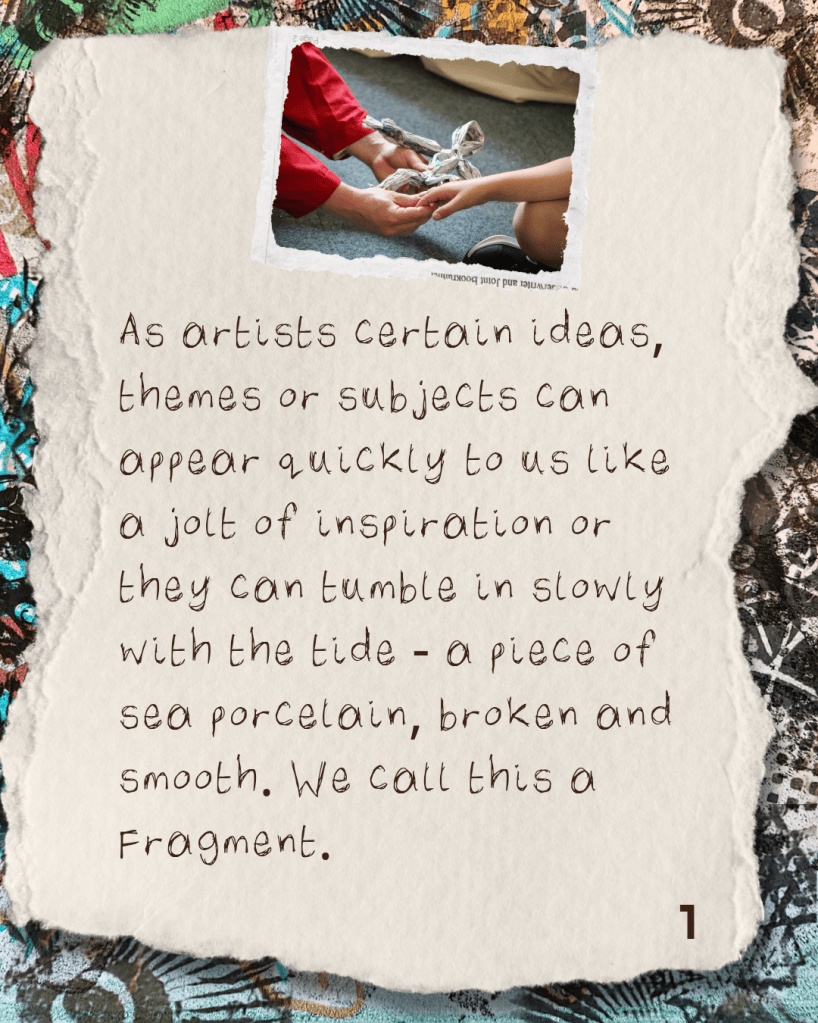
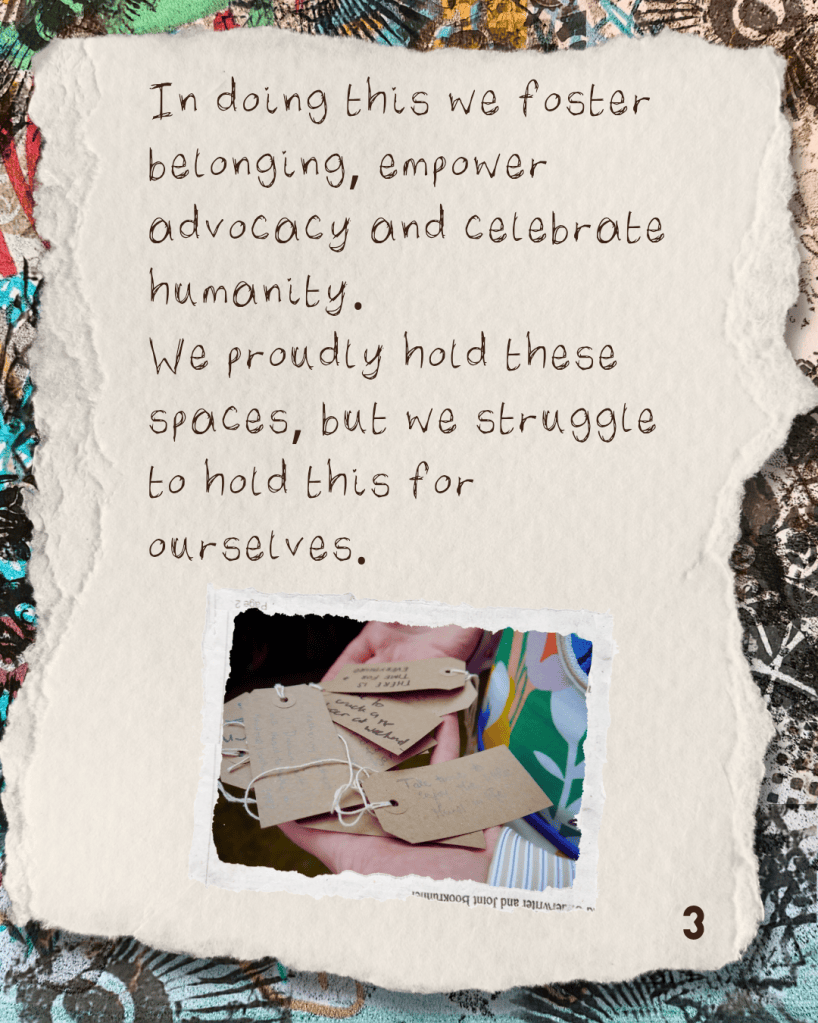
As artists certain ideas, themes or subjects can appear quickly to us like a jolt of inspiration or they can tumble in slowly with the tide – a piece of sea porcelain, broken and smooth. We call this a Fragment. Over our projects, we collect these Fragments – tiny stories, drawings, objects, laughter and whispers and build this together. A gradual steady process as responsive as the sea to the moon. Smaller ideas linking and merging over time, built by the folk who join us, responsive to the world they inhabit. Connecting with life events over many months and years. In doing this we foster belonging, empower advocacy and celebrate humanity. We proudly hold these spaces, but we struggle to hold this for ourselves.
Post 2
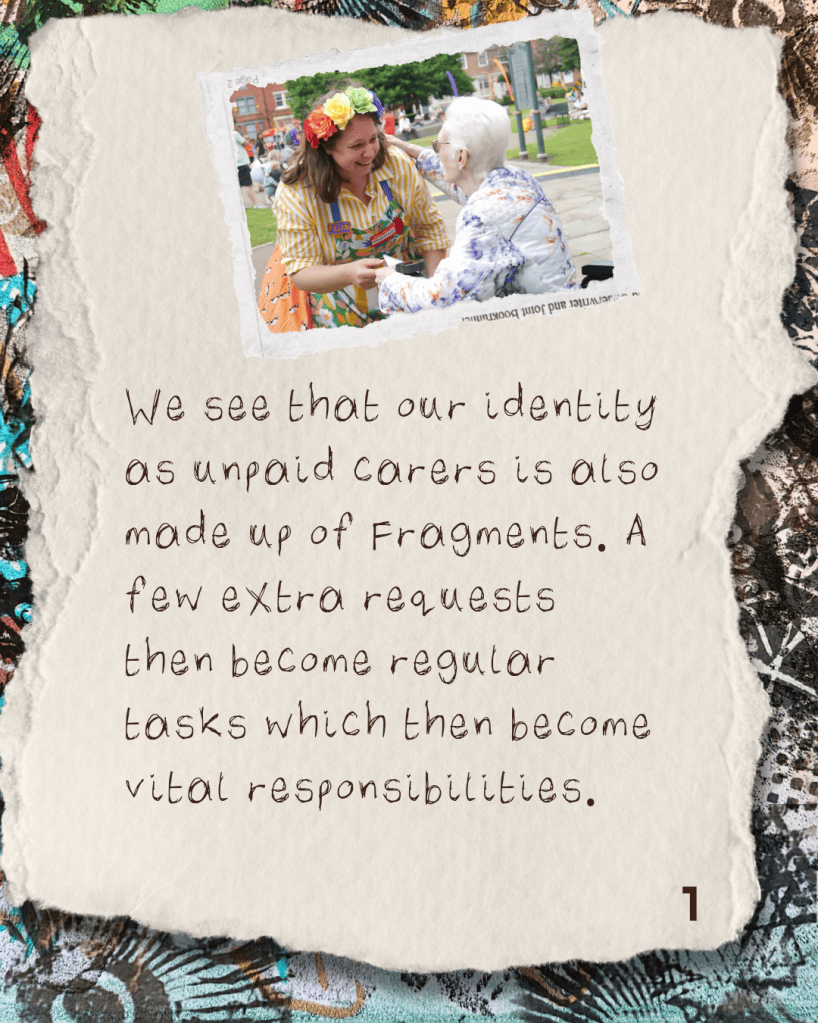
We see that our identity as unpaid carers is also made up of Fragments. A few extra requests then become regular tasks which then become vital responsibilities. It took us a long time to understand that we were unpaid carers. A friend asked one of us ‘What makes you a carer and not just a parent?’
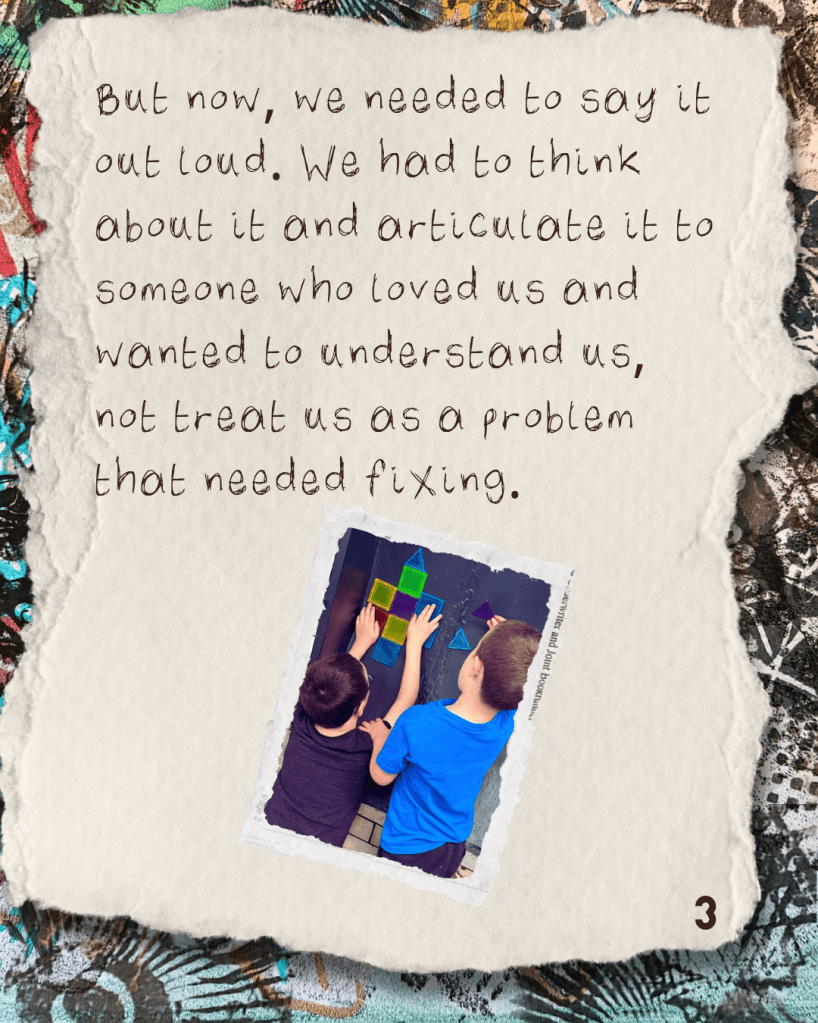
Before this point we had seen this label on a form. It belonged to the system and not us. The system that defined our level of need and support. But now, we needed to say it out loud. We had to think about it and articulate it to someone who loved us and wanted to understand us, not treat us as a problem that needed fixing.
Post 3
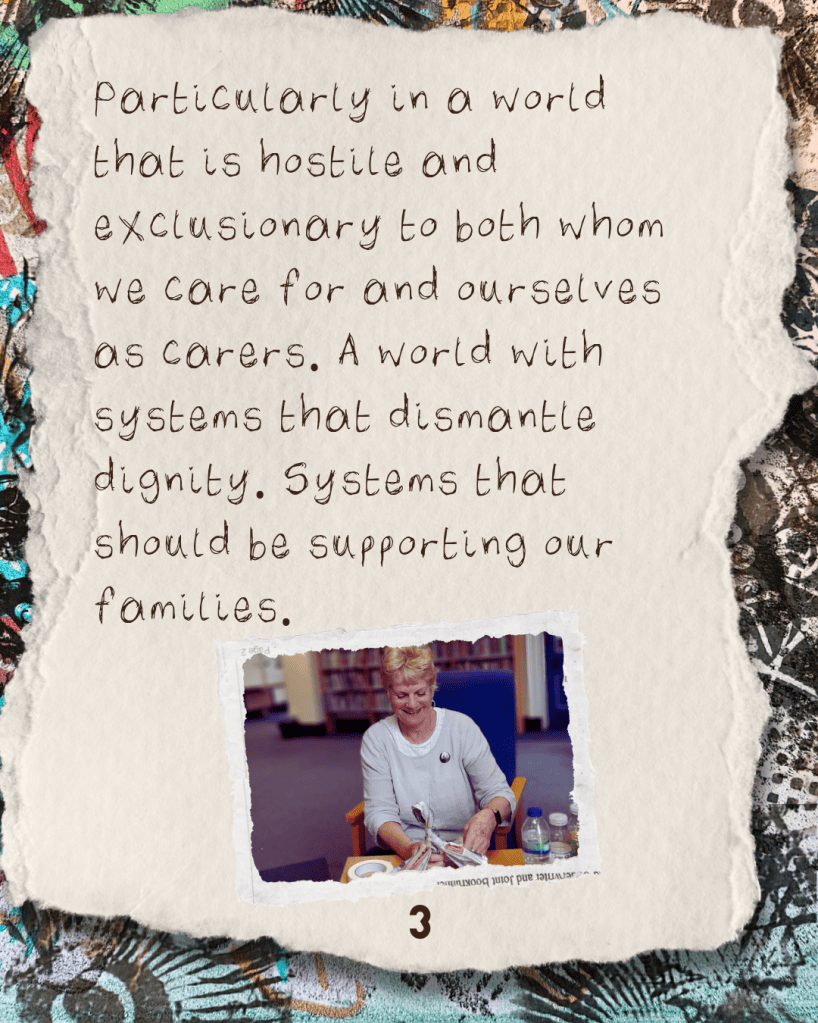
To accept the title Carer ourselves, we had to realise it in the first place. Even the title feels at times something that does not belong to us. The word throws up identities that are incredibly broad. Yet, our life as unpaid carers is deeply personal and tied to the person we care for. It feels private. Like something worth protecting. Particularly in a world that is hostile and exclusionary to both whom we care for and ourselves as carers. A world with systems that dismantle dignity. Systems that should be supporting our families.
Post 4
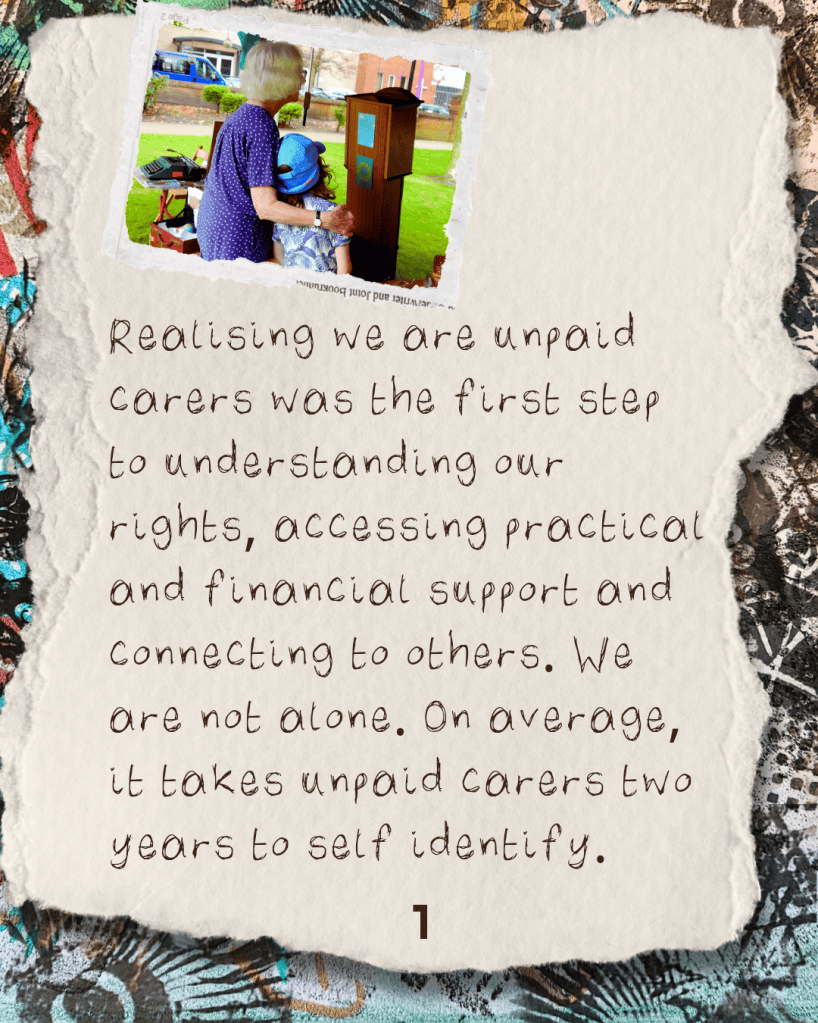
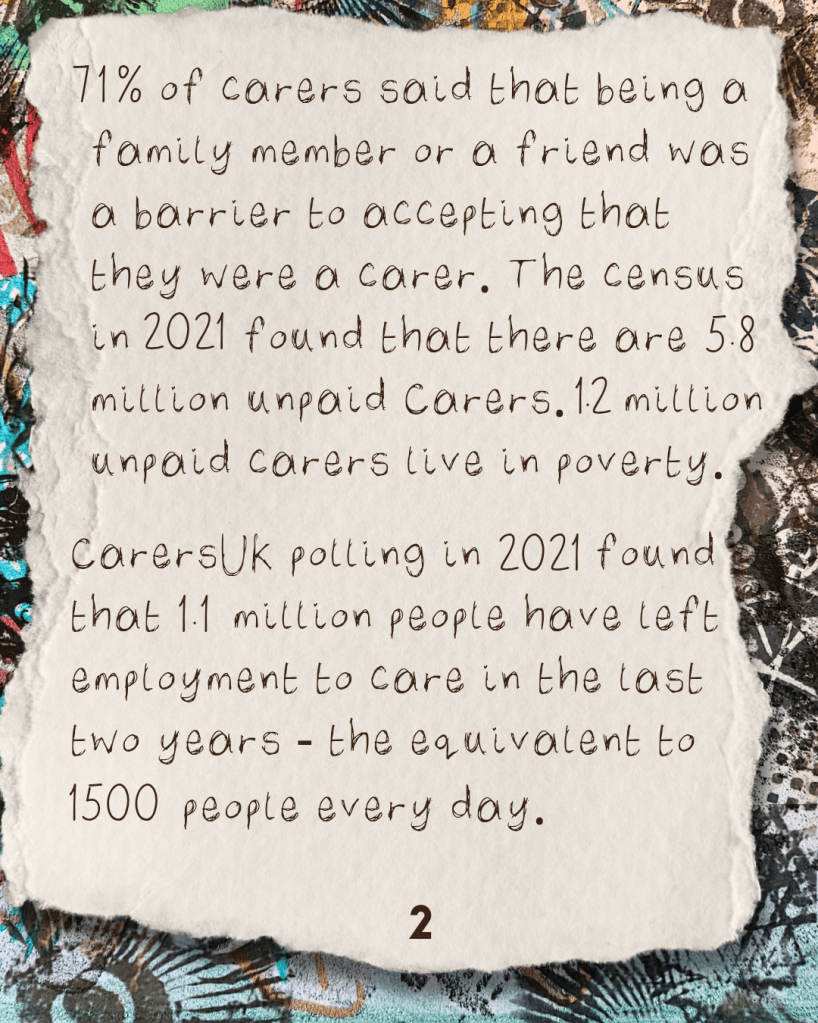
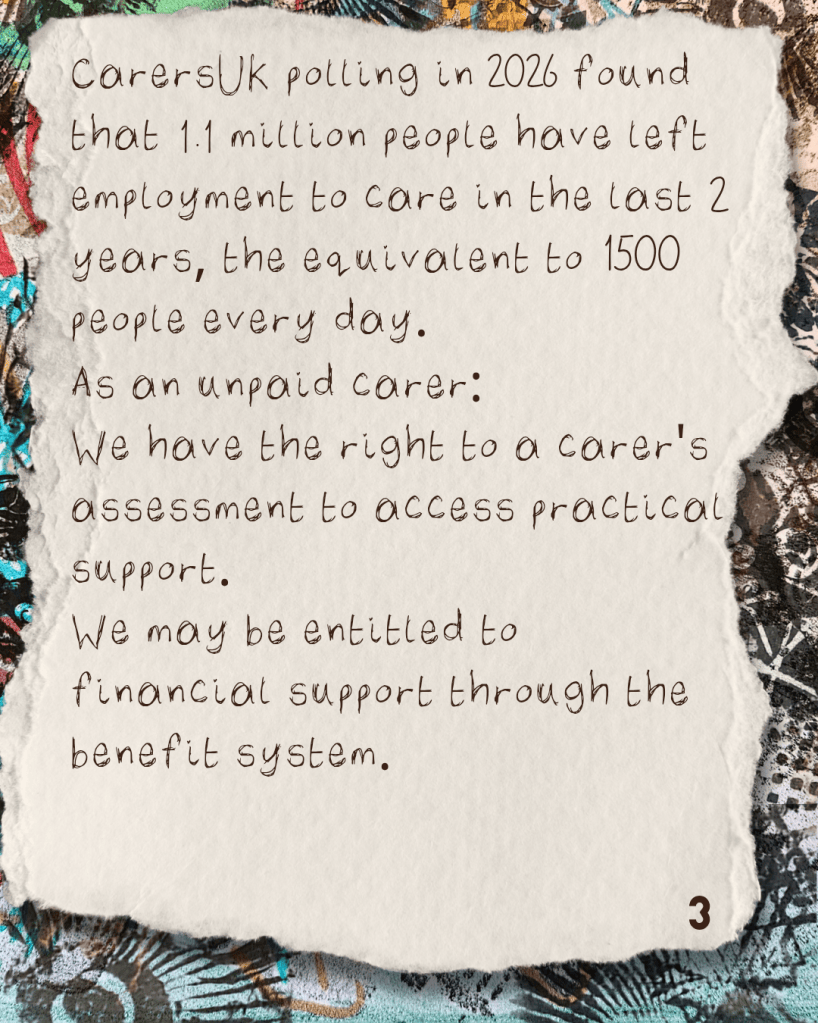
Realising we are unpaid carers was the first step to understanding our rights, accessing practical and financial support and connecting to others. We are not alone. On average, it takes unpaid carers 2 years to self identify. 71% of carers said that being a family member or a friend was a barrier to accepting that they were a carer. The census in 2021 found that there are 5.8 million unpaid Carers. 1.2 million unpaid carers live in poverty. CarersUK polling in 2026 found that 1.1 million people have left employment to care in the last 2 years – the equivalent to 1500 people every day.
As an unpaid carer:
We have the right to a carer’s assessment to access practical support
We may be entitled to financial support through the benefit system.
We can ask our GP to identify us as a carer who can refer us to local support and help us understand what we are entitled to – like a free flu jab.
At work we can access unpaid carer’s leave and request flexible working.
Carers UK has a wealth of resources and information about how to navigate these systems.
Post 5
Over the last year, we have been working, largely privately, to process how to create meaningful, representative experiences for Carers. We have been supported both as a collective and as individual artists. We are learning that to care is a verb that does not have an ending. To care is not a problem to be resolved. This is hard for us as storytellers to lose the plot. But all we have is right here and right now, so our work is going to be about the present. What ideas emerge in this moment, who we are in this room with this group of people, what world are we responding to. This has been happening incidentally in our work and now we will be making this intentional and deliberate. We have been creating a framework, a world and a story that can support people entering this space as carers. We call this Story Threads. Many stitchers make the quilt.
Post 6
We are not quite ready to share our Story Threads yet. When it arrives it will be something you can access in your own time, in your own home, and at a pace that works for you. Because we are aiming to reduce obligation and raise flexibility. We want to foster belonging, empower advocacy and celebrate humanity.


